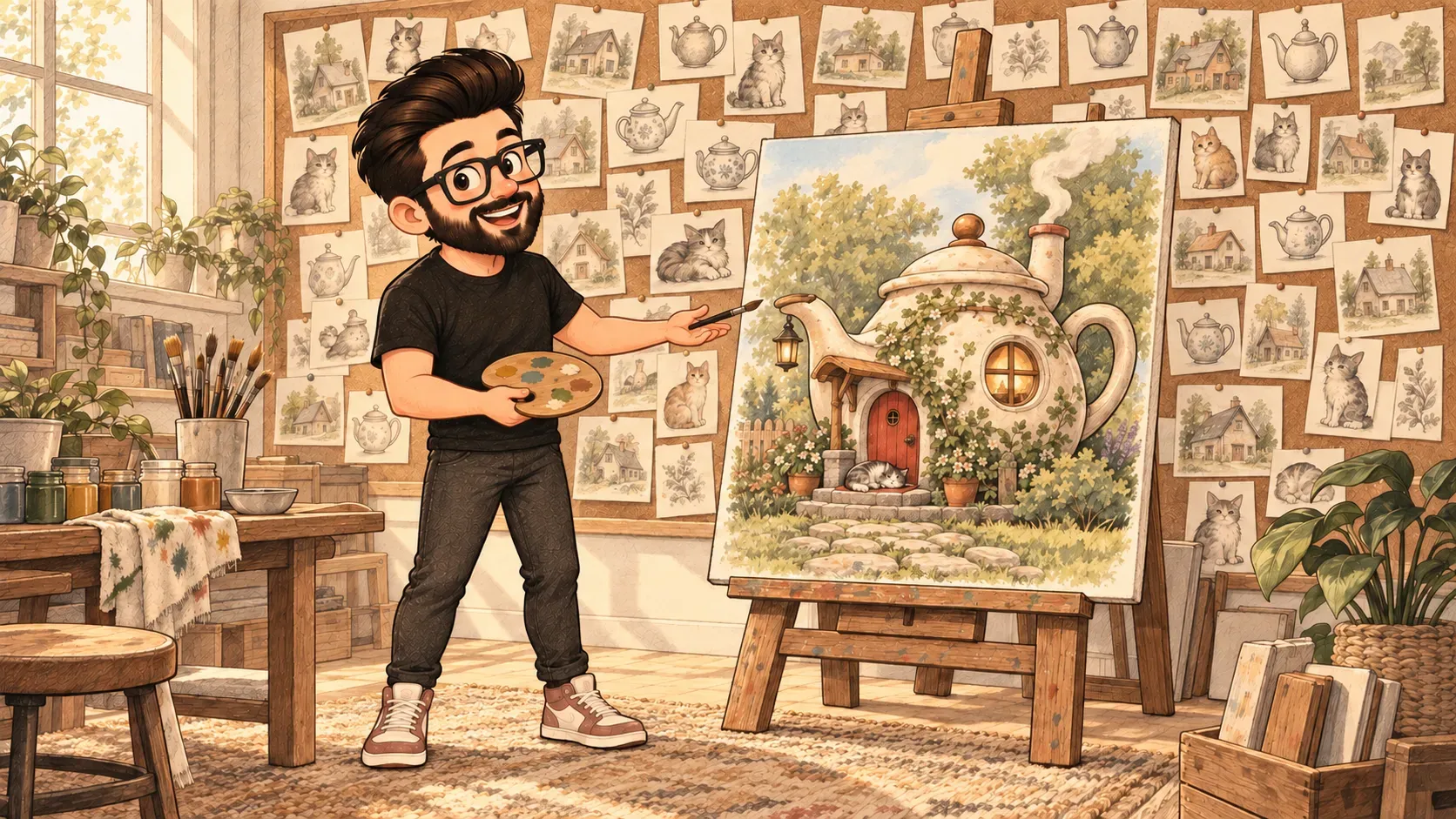

For years, AI mostly answered questions about things that already existed, like “is this spam?”. Generative AI makes something that didn't exist a moment ago.
Imagine an artist who has spent years studying pictures: thousands of cottages, thousands of teapots, thousands of cats. Ask them for a cottage shaped like a teapot, with a cat asleep on the doorstep, and they can paint it, even though nobody has ever shown them one.
They aren’t copying any single picture. They’ve learned what cottages, teapots and cats tend to look like, and they combine that into something new.
That’s generative AI. It learns the patterns in a huge number of examples, then uses them to make new text, pictures, music or code whenever you ask.
Sorting vs making
For years, most AI sorted and predicted: spam or not spam, which film you’d probably like, how bad the traffic will be. Its answer was a label or a number.
Generative AI’s answer is a whole new thing: a paragraph, a picture, a song, a working piece of code. That shift, which reached everyday people with ChatGPT at the end of 2022, is why everyone suddenly started talking about AI.
What it can make
- emails, essays and summaries
- pictures from a written description
- voices and music
- computer code
- short video clips
How it does it
Underneath, it’s still machine learning: practice on an enormous number of examples. What’s different is what it practised. A text generator practised guessing the next word across billions of sentences. A picture generator practised turning a fuzzy, noisy mess back into a clear picture, step by step.
When you ask for something, it builds the answer a small piece at a time, each time picking what’s most likely to fit.
What it isn’t
It isn’t looking anything up, and it doesn’t know whether what it makes is true. It makes what looks right, based on its examples. Usually that’s correct too. Sometimes it confidently produces a fact, a quote or a source that doesn’t exist. That’s called a hallucination.
And because it learned from other people’s writing and art, questions about copyright and credit are still being argued over.
How the words fit together
AI is the umbrella. Machine learning is how almost all of it learns. Generative AI is the kind of AI that makes new things. An LLM is generative AI for words, the engine behind ChatGPT.
Treat what it makes as a first draft. It's brilliant at getting you past a blank page, but you still need to check the facts and add the parts only you know.

When you'll hear it
“We used GenAI for this.” Some of the words, pictures or code were made by AI, hopefully then checked and edited by a person.
“This image is AI-generated.” No camera and no artist. It was made from a description someone typed.
“It's just a wrapper around GenAI.” The product mostly passes your request to someone else's generative AI, like ChatGPT, and shows you what comes back.
“Which parts of this did a person check, and which came straight out of the AI?”