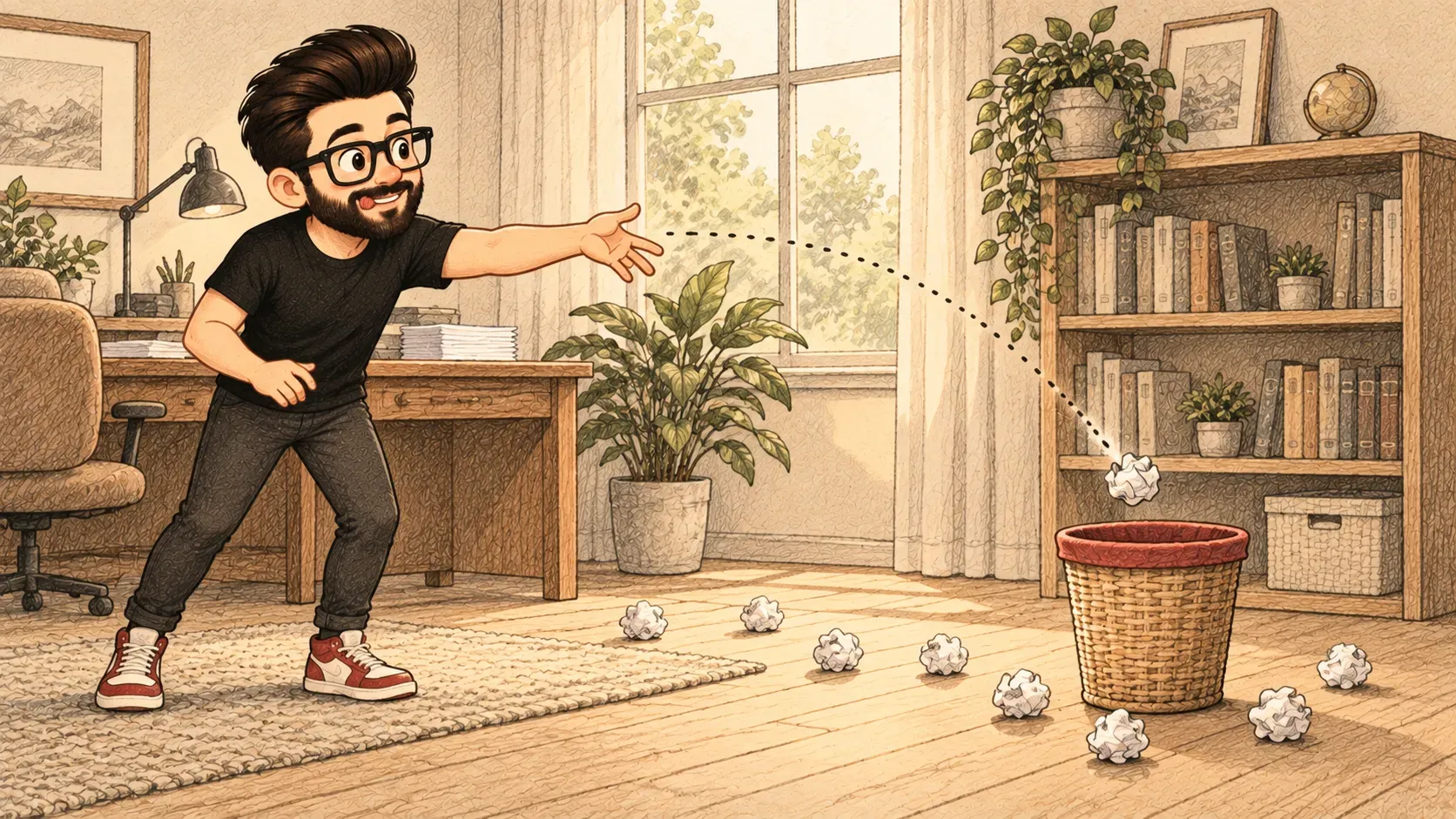

Nobody gets a paper ball into the bin on the first throw. You miss, notice how you missed, and adjust. Machine learning is a computer doing exactly that, millions of times.
Picture throwing a crumpled piece of paper at a bin across the room. First throw: way too short. You throw harder. Now it sails past. A little softer. Closer. Each miss tells you two things: which way you were off, and by how much. A few throws later, it drops in.
You never worked out the physics. You didn’t write down a rule for how hard to throw. You just practised, and paid attention to how you missed.
That’s machine learning. The computer makes a guess, checks it against the right answer, nudges itself to be a little less wrong, and repeats, millions of times, until its guesses are good.
How it actually learns
Say you want software that spots spam.
- Collect examples. Thousands of emails, each already marked “spam” or “not spam” by a person.
- Guess. The computer looks at an email and guesses. At first, its guesses are basically random.
- Check. It compares its guess with the real answer.
- Adjust. It tweaks its internal settings a tiny bit, so it’s slightly more likely to get that kind of email right next time.
- Repeat. Through every example, often many times over.
This practice phase is called training. What comes out at the end, the finished thing that makes the guesses, is called a model.
Then it plays for real
Once it’s trained, the model stops practising and simply uses what it learned on emails it has never seen. That’s your spam folder quietly catching the junk every day. The same recipe, with different examples, is behind face unlock, film recommendations, voice assistants and ChatGPT.
Machine learning vs AI
AI is the goal: software that does something we’d normally call smart. Machine learning is the way almost all of it gets there today, by practising on examples instead of following rules a person wrote. Nearly everything you hear called AI right now is machine learning underneath.
What it isn’t
It isn’t understanding. The spam model has no idea what an email means. It has just become very good at noticing the patterns junk mail tends to have. And practice doesn’t make it perfect. If spammers invent a new trick it never practised on, it can slip straight past.
A model is only as good as its practice. If the examples it learned from are old, narrow or wrong, it gets very good at the wrong thing.

When you'll hear it
“We're training a model.” It's in the practice phase, guessing, being corrected and adjusting, over and over.
“The model is 95% accurate.” In testing, it got 95 out of 100 right. Always worth asking what it was tested on.
“We need more data.” It needs more examples to practise on before its guesses are good enough.
“What examples is it learning from, and how will we know when it's getting things wrong?”